OUTthere Magazine : Issue 68
Whether it’s expressing the soccer team to their Saturday showdown or packing the troupe for a weekend getaway, the modern seven-seater is a triumph in family logistics. Gone are the days of bench seats, lap riding and rolling around the rear of the station wagon. We survey the standout performers.
Are we never satisfied? Folks my age remember packing the family into the vinyl upholstered station wagon, sliding along the bench seat sometimes four or five skinny kids wide and sweating it out all the way to the beach. No wonder backyard pools were so popular.
Today’s checklist for modern people-movers include air-conditioning, leather bucket seats with lap/sash belts for all and a barrage of airbags inside a reinforced and galvanized chassis. The boxy minivans of the ‘80s and early ‘90s are passé now that seven adults can travel in luxurious comfort in a vehicle smaller than the old HQ. Don’t even mention fuel economy.
Honda Odyssey
Exemplary build quality and safety makes the sleek, multi award-winning Odyssey a perfect tourer for the larger family in the better neighbourhood. With 2.4L DOHC i-VTEC engine and 5-speed auto, the fourth generation model begins at $41,990 for standard.
Holden Captiva 7
The Korean-built Captiva SUV is a hit with mums according to AutoChic website. Small families can even downsize to the 5-seat version and go 2WD too. An economical diesel is available and bags of safety features too like ABS and electronic stability control (ESP). Captiva 7 starts at $35,490
Subaru Tribeca 3.6R Premium
A slow starter in the market, the latest Tribeca AWD squarely addresses initial criticisms by smartening up the styling and bulking up under the bonnet. Handy as a light off-roader, the Tribeca has all the smart Subaru gear and the new 3.6l engine kicks 190kW. Save up though. Starts at $58,990
Mazda CX-9 Classic
First introduced in late ’07, the latest CX-9 is in showrooms now and is absolutely chockers with all the latest safety kit and driver aids and $2k cheaper than the model it replaces. Bold new styling and ballsy 3.7l V6 sets CX-9 apart. Classic starts at $49,990
Toyota Tarago V6 GLi
Tarago is almost a euphemism for people-mover, but today’s offering is a far cry from the minibus–like van introduced 26 years ago. Tarago, which is derived from an Aboriginal word meaning “my country” is only sold in Australia with this badge. Available in lusty 3.5 V6 (starts $54,690) or 2.4 litre 4-cylinder ($49,490)
Ford Territory TS RWD
The locally designed Territory has always been a hit with Aussie families. The big 4.0l six and sure-footed 2- or 4WD options made the burly SUV an instant hit with boat owners, caravanners and sports mums. With a new look for 2009, the extra seats only some with TS RWD ($44,490)

Online since 1996. Automotive, motorcycle, 4WD and Drive Travel Stories. Everything automotive culture.
01 February 2010


VW Golf GTI: On Your Marks: Nine into One Goes
Volkswagen Magazine : Issue 14 : Summer 2010
Roderick Eime traces the GTI’s 33 years of progress
When a car is this overwhelmingly successful, the world takes note. What is it about this little Volkswagen that so captured the imagination of car enthusiasts across the planet? Intended as a modest replacement for the ageing, yet evergreen Beetle, the Golf took off like no-one expected.
Named after, not the famous ball game, but instead the ferocious wind: Gulf Stream. Golf was a complete departure from Doktor Ferdinand Porsche’s original vision of the ‘People’s Car’. Instead of rear-mounted, air-cooled and rear wheel drive, the complete opposite was engineered into the new VW mass market machine.
In all its incarnations, the VW Golf is now the world’s third best selling vehicle with over 26,000,000 made and sold. It passed the venerable Beetle’s mere 21,500,000 in 2002.
But while mum, dad and Aunt Vera were happy to motor sedately in their new Golf runabout, the backroom lads were already plotting the steroidal version for the more ‘enthusiastic’ driver. Here mystery and legend come into play as the tale of the GTI’s development is told.
In the early ‘70s, Volkswagen wasn’t in a particularly bold frame of mind. Car companies were generally spooked by the rise of global terrorism and the uncertainty of oil supply. A bunch of hotheads talking about performance cars was not getting much of a hearing. So the boys went underground, literally, into a bierkeller to hatch (pun intended) their plans over pilsener and bratwurst.
Engineers were joined by marketers and public relations men in the subterranean trysts. Other manufacturers, the growing team observed, were leading buyers away from rivals by dressing up the vanilla-flavoured models with racing stripes and a few race-bred bits under the bonnet. Ford, for example, were successfully leveraging their relationship with Lotus and Cosworth to make ‘party animal’ Cortinas and Escorts that publicly flexed their muscles on the race track. These results translated into sales with the famous motto: “Race on Sunday, Sell on Monday”.
Persistence paid off and the project dubbed “Sport Golf” began to get official recognition and six prototypes were approved. These were displayed at the 1975 Frankfurt Motor Show and the seed was sown. 5000 limited production units were built and dispersed throughout the dealer network and the resulting interest was unstoppable to the point where production of the LHD-only version was running at 5000 units per month.
The Mk1 Golf GTI profited from the recent corporate merger between Audi, NSU and VW and the Audi-developed, 1600cc 8-valve engine was employed, fed by a then state-of-the-art Bosch K-Jetronic fuel injection system. The little beast erupted with 81kW at full noise, propelling the 800kg car to 100kmh in nine seconds and on to a top speed of 180kmh – respectable enough to mix it with the big boys on the Autobahn.
The UK market was clamouring for a RHD version, but their appetite for the GTI had to wait until 1979 for a production version. Just as the European precedent had already been set, sales of 1500 in the first year tripled in the following 24 months.
By this time the phenomenon of the Volkswagen Golf GTI has spread like wildfire among its competitors and the ‘hot hatchback’ concept was born, spawning copycat models from France, Britain, Japan and Italy. The genre was now a permanent and mandatory segment of automotive manufacturers’ repertoire.
While the world was enjoying the GTI, the wait was even more frustrating for Australians. While the original, regular Golfs had been assembled here almost since the model’s introduction, the first GTIs didn’t go on sale until 1990 and then in a “knobbled” Mk.II version because of inability to supply the new and preferred 16 valve engine in compliance with Australian emission rules. To further rub salt, the uber-hot 4WD, supercharged G60 Limited would not come Down Under at all.
The early nineties saw Golf GTI fall into a mild form of the doldrums. The world was in turmoil again over oil in the Middle East and carmakers across the globe were pre-occupied with meeting the demands of frugal buyers. In an inspirational and lateral move, VW introduced a surprisingly potent turbo-charged diesel engine and the GTI TDI was born. Introduced in Europe in 1991, the GTI Mk.III never made it here
While critics and enthusiasts alike had mixed feelings about the heavy and lazy Mk.III, the 1997 launch of the fourth generation GTI restored interest, but not immediately. While press reports extolled its refined handling and finish, some of the original spark that set the GTI alight back in the ‘70s was missing. VW and Audi production was now more closely linked than ever and the new A3 and Golf GTI Mk.IV were not so much cousins as siblings.
Australians first saw this model in 1999 and despite the anticipation, we were not overly moved by the low-boost turbo 1.8-litre four cylinder with 20-valve head, delivering just 110kW in a chassis that was 50 per cent heavier than the original GTI. Germany reacted by loading the 25th Anniversary model with a 132kW 1.8-litre turbo. While this new powerplant wasn’t seen here for that model, the message was loud and clear: more power thanks.
The arrival of the Mk.V at the 2004 Paris Motor Show was like a second coming. Someone had put a rocket up the design and development team and this new model revived both the prestige and the fortunes of the languishing GTI. It looked the goods and had the notoriously cynical motoring press sitting upright.
“Decades of disappointment end here,” wrote Wheels journalist Nathan Ponchard at the time of its launch in 2005. “It takes just five minutes of hard driving to discover that Volkswagen’s all-new Mk.V Golf GTI is far beyond the mediocre efforts of all its predecessors. It’s the first Golf GTI sold in this country that goes as hard as it looks and, more importantly, actually fulfils your expectations of the badge.”
Volkswagen had a new swagger in their step and the 147kW 2.0 litre turbo-charged engine matched to either a six-speed manual transmission or the much-lauded six speed automatic (with dual clutch, no less) had the GTI back on its aspirational pedestal with a more reasonable price tag.
Visually the Mk.V harked back to the original GTI with the return of the tartan interior and the red surround to the grille element. Even the typeface used on the badge echoes that of the original. Furthermore, this new model served as a base for two special editions, the Pirelli and Edition 30. Both models are powered by an up-rated evolution of the 2.0-litre T-FSI engine fitted to the conventional GTI.
Paris 2008 was again the venue for the debut of the newest model Golf, the Mk.VI. The GTI, however, had to wait until March this year in Geneva to show its hand. At this point in its life, 1.7 million GTIs had been sold worldwide, cementing legend status for this cult car.
Australia is on tenterhooks for a late-2009 arrival of this next model which will coincide with the venerable GTI’s 33rd anniversary. A new 7-speed twin clutch DSG (direct shift gearbox) will be offered, designed to improve both performance and economy.
Expect a top speed of around 238kmh, but despite the power increase to 155kW, the engine will more efficient and deliver improved fuel economy on both the city and highway cycles. The visual and technical design remains faithful to the original brief of the original 1976 model, namely startling performance with maximum driver enjoyment and engagement in an understated package.
What will be unrecognisable, however, is the array of technical and safety features that will make the landmark GTI pale by comparison. Add seven airbags, a five star NCAP crash rating, a dynamic chassis control (DCC) system, XDS electronic transverse differential lock and six-speed manual and DSG twin-clutch gearboxes and you have the comparison equivalent of a Spitfire and an F-18.
The powerplant is a second stage development of the EA888 2.0-litre turbocharged four-cylinder engine. It has minor modifications to the pistons, oil and fuel pumps and induction system, while the torque is more accessible than before, delivered earlier in the range for better throttle response.
While the GTI may have travelled a winding path through its various incarnations, many will believe development has run a full circle, returning to the core values that inspired the original design and development conspirators who colluded 35 years ago to bring the model to market.
Roderick Eime traces the GTI’s 33 years of progress
When a car is this overwhelmingly successful, the world takes note. What is it about this little Volkswagen that so captured the imagination of car enthusiasts across the planet? Intended as a modest replacement for the ageing, yet evergreen Beetle, the Golf took off like no-one expected.
Named after, not the famous ball game, but instead the ferocious wind: Gulf Stream. Golf was a complete departure from Doktor Ferdinand Porsche’s original vision of the ‘People’s Car’. Instead of rear-mounted, air-cooled and rear wheel drive, the complete opposite was engineered into the new VW mass market machine.
In all its incarnations, the VW Golf is now the world’s third best selling vehicle with over 26,000,000 made and sold. It passed the venerable Beetle’s mere 21,500,000 in 2002.
But while mum, dad and Aunt Vera were happy to motor sedately in their new Golf runabout, the backroom lads were already plotting the steroidal version for the more ‘enthusiastic’ driver. Here mystery and legend come into play as the tale of the GTI’s development is told.
In the early ‘70s, Volkswagen wasn’t in a particularly bold frame of mind. Car companies were generally spooked by the rise of global terrorism and the uncertainty of oil supply. A bunch of hotheads talking about performance cars was not getting much of a hearing. So the boys went underground, literally, into a bierkeller to hatch (pun intended) their plans over pilsener and bratwurst.
Engineers were joined by marketers and public relations men in the subterranean trysts. Other manufacturers, the growing team observed, were leading buyers away from rivals by dressing up the vanilla-flavoured models with racing stripes and a few race-bred bits under the bonnet. Ford, for example, were successfully leveraging their relationship with Lotus and Cosworth to make ‘party animal’ Cortinas and Escorts that publicly flexed their muscles on the race track. These results translated into sales with the famous motto: “Race on Sunday, Sell on Monday”.
Persistence paid off and the project dubbed “Sport Golf” began to get official recognition and six prototypes were approved. These were displayed at the 1975 Frankfurt Motor Show and the seed was sown. 5000 limited production units were built and dispersed throughout the dealer network and the resulting interest was unstoppable to the point where production of the LHD-only version was running at 5000 units per month.
The Mk1 Golf GTI profited from the recent corporate merger between Audi, NSU and VW and the Audi-developed, 1600cc 8-valve engine was employed, fed by a then state-of-the-art Bosch K-Jetronic fuel injection system. The little beast erupted with 81kW at full noise, propelling the 800kg car to 100kmh in nine seconds and on to a top speed of 180kmh – respectable enough to mix it with the big boys on the Autobahn.
The UK market was clamouring for a RHD version, but their appetite for the GTI had to wait until 1979 for a production version. Just as the European precedent had already been set, sales of 1500 in the first year tripled in the following 24 months.
By this time the phenomenon of the Volkswagen Golf GTI has spread like wildfire among its competitors and the ‘hot hatchback’ concept was born, spawning copycat models from France, Britain, Japan and Italy. The genre was now a permanent and mandatory segment of automotive manufacturers’ repertoire.
While the world was enjoying the GTI, the wait was even more frustrating for Australians. While the original, regular Golfs had been assembled here almost since the model’s introduction, the first GTIs didn’t go on sale until 1990 and then in a “knobbled” Mk.II version because of inability to supply the new and preferred 16 valve engine in compliance with Australian emission rules. To further rub salt, the uber-hot 4WD, supercharged G60 Limited would not come Down Under at all.
The early nineties saw Golf GTI fall into a mild form of the doldrums. The world was in turmoil again over oil in the Middle East and carmakers across the globe were pre-occupied with meeting the demands of frugal buyers. In an inspirational and lateral move, VW introduced a surprisingly potent turbo-charged diesel engine and the GTI TDI was born. Introduced in Europe in 1991, the GTI Mk.III never made it here
While critics and enthusiasts alike had mixed feelings about the heavy and lazy Mk.III, the 1997 launch of the fourth generation GTI restored interest, but not immediately. While press reports extolled its refined handling and finish, some of the original spark that set the GTI alight back in the ‘70s was missing. VW and Audi production was now more closely linked than ever and the new A3 and Golf GTI Mk.IV were not so much cousins as siblings.
Australians first saw this model in 1999 and despite the anticipation, we were not overly moved by the low-boost turbo 1.8-litre four cylinder with 20-valve head, delivering just 110kW in a chassis that was 50 per cent heavier than the original GTI. Germany reacted by loading the 25th Anniversary model with a 132kW 1.8-litre turbo. While this new powerplant wasn’t seen here for that model, the message was loud and clear: more power thanks.
The arrival of the Mk.V at the 2004 Paris Motor Show was like a second coming. Someone had put a rocket up the design and development team and this new model revived both the prestige and the fortunes of the languishing GTI. It looked the goods and had the notoriously cynical motoring press sitting upright.
“Decades of disappointment end here,” wrote Wheels journalist Nathan Ponchard at the time of its launch in 2005. “It takes just five minutes of hard driving to discover that Volkswagen’s all-new Mk.V Golf GTI is far beyond the mediocre efforts of all its predecessors. It’s the first Golf GTI sold in this country that goes as hard as it looks and, more importantly, actually fulfils your expectations of the badge.”
Volkswagen had a new swagger in their step and the 147kW 2.0 litre turbo-charged engine matched to either a six-speed manual transmission or the much-lauded six speed automatic (with dual clutch, no less) had the GTI back on its aspirational pedestal with a more reasonable price tag.
Visually the Mk.V harked back to the original GTI with the return of the tartan interior and the red surround to the grille element. Even the typeface used on the badge echoes that of the original. Furthermore, this new model served as a base for two special editions, the Pirelli and Edition 30. Both models are powered by an up-rated evolution of the 2.0-litre T-FSI engine fitted to the conventional GTI.
Paris 2008 was again the venue for the debut of the newest model Golf, the Mk.VI. The GTI, however, had to wait until March this year in Geneva to show its hand. At this point in its life, 1.7 million GTIs had been sold worldwide, cementing legend status for this cult car.
Australia is on tenterhooks for a late-2009 arrival of this next model which will coincide with the venerable GTI’s 33rd anniversary. A new 7-speed twin clutch DSG (direct shift gearbox) will be offered, designed to improve both performance and economy.
Expect a top speed of around 238kmh, but despite the power increase to 155kW, the engine will more efficient and deliver improved fuel economy on both the city and highway cycles. The visual and technical design remains faithful to the original brief of the original 1976 model, namely startling performance with maximum driver enjoyment and engagement in an understated package.
What will be unrecognisable, however, is the array of technical and safety features that will make the landmark GTI pale by comparison. Add seven airbags, a five star NCAP crash rating, a dynamic chassis control (DCC) system, XDS electronic transverse differential lock and six-speed manual and DSG twin-clutch gearboxes and you have the comparison equivalent of a Spitfire and an F-18.
The powerplant is a second stage development of the EA888 2.0-litre turbocharged four-cylinder engine. It has minor modifications to the pistons, oil and fuel pumps and induction system, while the torque is more accessible than before, delivered earlier in the range for better throttle response.
While the GTI may have travelled a winding path through its various incarnations, many will believe development has run a full circle, returning to the core values that inspired the original design and development conspirators who colluded 35 years ago to bring the model to market.
01 January 2010
Honda: One Small Step for a Man
OUTthere Magazine : Issue 67
Roderick Eime reminisces on Honda’s history on the occasion of its fortieth anniversary in Australia.
Forty years ago, a humble man in a big suit stepped onto the surface of the moon and uttered those famous words. On a different scale perhaps, but when Hidehiko Shiomi set up shop in a Melbourne flat, his mission was also the first step in a momentous journey.
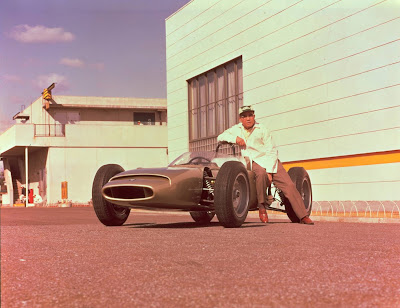 |
| Soichiro Honda with the 1963 Honda RA270F prototype Formula one car |
Forty years ago, a humble man in a big suit stepped onto the surface of the moon and uttered those famous words. On a different scale perhaps, but when Hidehiko Shiomi set up shop in a Melbourne flat, his mission was also the first step in a momentous journey.
01 December 2009
Driving to Save the World
OUTthere Magazine : Issue 66
The days of the gas-guzzler are over. Cheap petrol is a thing of the past, and if the rising cost of fuel wasn’t enough to sway us, then pleas from our suffering planet should change our minds.
We’re stuck with roads, cars, buses and trucks for the short term, so rather than look for a ‘tardis’ solution, it is clearly more practical to investigate alternative fuels for existing combustion engines and beyond that, new propulsion systems for the next wave of vehicles.
Roderick Eime examines and rates some current and near-future developments
Good: Biofuels
Fuel from vegetable sources has had a lot of publicity recently. Sir Richard Branson flew one of his Virgin jetliners using some coconut and palm-derived biofuel in a well-publicised test, but the jury is still out. Certainly, the source of biofuel is renewable, but critics point out that crops like corn and maize are better used to feed hungry humans than fly rich ones. Brazilians on the other hand, have greatly reduced their reliance on oil for petrol by using sugarcane waste for ethanol. Here in Australia, ethanol is already in our fuel tanks as is biodiesel for our trucks and heavy equipment. The net benefit of biofuel is still under debate, as their burning does produce greenhouse gasses. Supporters argue that the growing of the fuel source reabsorbs the carbon emitted during combustion, bolstering their “carbon neutral” claim.
Better: Petrol- Electric Hybrids
Some experts predict the current eco-vehicles are just an interim measure until even more efficient vehicles arrive. Chances are at least several of you are owners of hybrid vehicles like Toyota Prius, Honda Civic Hybrid or Lexus, while others will have driven one as a hire car. In hybrids, a conventional petrol engine is supplemented by banks of NiMH batteries (like those in mobile phones) driving a powerful electric motor. Under coasting or braking, the energy generated is fed back to recharge them, delivering impressively low gasoline mileage.
Outstanding! Hydrogen Fuel Cells

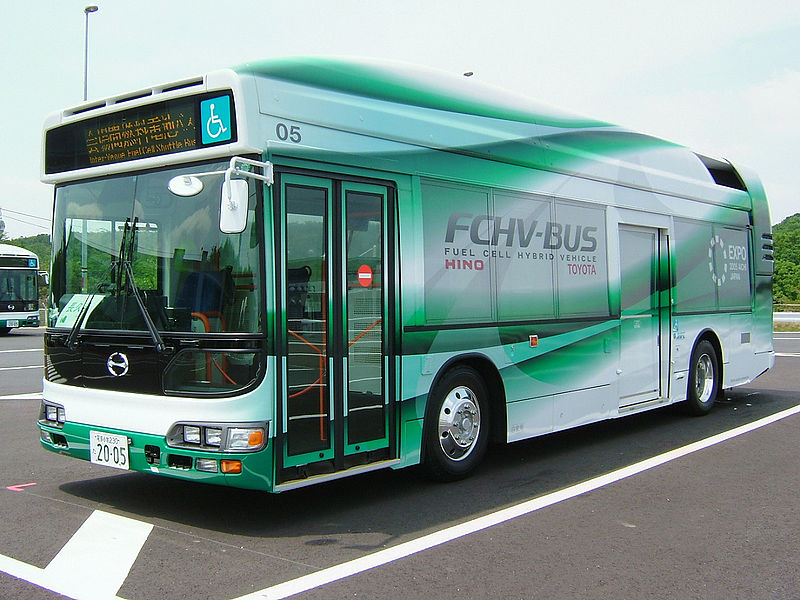
Think of hydrogen and it immediately conjures visions of the exploding Hindenberg airship. Sure, hydrogen is volatile, but it’s also extremely lightweight and efficient when used in a fuel cell. Hydrogen fuel cells work along the same lines as a regular torch or car battery, but instead of acids and fluids, the reactants are gases, the other one being oxygen from the air. Fill up like LPG and away you go and the only emissions are water vapour. It’s only a matter of time before full commercially viable vehicles join the limited experimental ones currently on the road. Japan, unsurprisingly, is leading the way with eleven hydrogen fuel stations already operating as part of their “Hydrogen Highway”.
 See PDF
The days of the gas-guzzler are over. Cheap petrol is a thing of the past, and if the rising cost of fuel wasn’t enough to sway us, then pleas from our suffering planet should change our minds.
We’re stuck with roads, cars, buses and trucks for the short term, so rather than look for a ‘tardis’ solution, it is clearly more practical to investigate alternative fuels for existing combustion engines and beyond that, new propulsion systems for the next wave of vehicles.
Roderick Eime examines and rates some current and near-future developments
Good: Biofuels
Fuel from vegetable sources has had a lot of publicity recently. Sir Richard Branson flew one of his Virgin jetliners using some coconut and palm-derived biofuel in a well-publicised test, but the jury is still out. Certainly, the source of biofuel is renewable, but critics point out that crops like corn and maize are better used to feed hungry humans than fly rich ones. Brazilians on the other hand, have greatly reduced their reliance on oil for petrol by using sugarcane waste for ethanol. Here in Australia, ethanol is already in our fuel tanks as is biodiesel for our trucks and heavy equipment. The net benefit of biofuel is still under debate, as their burning does produce greenhouse gasses. Supporters argue that the growing of the fuel source reabsorbs the carbon emitted during combustion, bolstering their “carbon neutral” claim.
Better: Petrol- Electric Hybrids
Some experts predict the current eco-vehicles are just an interim measure until even more efficient vehicles arrive. Chances are at least several of you are owners of hybrid vehicles like Toyota Prius, Honda Civic Hybrid or Lexus, while others will have driven one as a hire car. In hybrids, a conventional petrol engine is supplemented by banks of NiMH batteries (like those in mobile phones) driving a powerful electric motor. Under coasting or braking, the energy generated is fed back to recharge them, delivering impressively low gasoline mileage.
Outstanding! Hydrogen Fuel Cells

Think of hydrogen and it immediately conjures visions of the exploding Hindenberg airship. Sure, hydrogen is volatile, but it’s also extremely lightweight and efficient when used in a fuel cell. Hydrogen fuel cells work along the same lines as a regular torch or car battery, but instead of acids and fluids, the reactants are gases, the other one being oxygen from the air. Fill up like LPG and away you go and the only emissions are water vapour. It’s only a matter of time before full commercially viable vehicles join the limited experimental ones currently on the road. Japan, unsurprisingly, is leading the way with eleven hydrogen fuel stations already operating as part of their “Hydrogen Highway”.
See PDF27 September 2009
Australia’s 1st National Electric Vehicle Festival

takes place in Canberra this coming long weekend featuring the Ferrari slaying electric Tesla from the USA.
Like a music festival, Australia’s first national electric vehicle festival delivers one main act – the Ferrari slaying Tesla Roadster – and is supported by plenty of interesting, solid support acts, such as: the 1917 vintage Detroit Electric; incredible electric motorbikes (like Vectrix, who will soon be selling bikes in Canberra); conversions of petrol powered cars; as well as the infrastructure needed for an electric vehicle world. It will be a great gig.
The main attraction for the festival will undoubtedly be the incredible Tesla Roadster that can sprint from 0 to 100km/h in just 3.9 seconds. That is Ferrari beating acceleration, from a car that has maximum torque at 0 km/h. There is only one Tesla in Australia and its biggest public appearance will be at the festival; on the lawns in front of Old Parliament House on Sunday 4 October, from 9am to 4pm.
“The Tesla is the first guilt-free high-performance sports car of our time. There is little else to say, it’s a dream. It pushes your stomach into the back of the seat with renewable energy, giving you a guilt-free adrenalin hit. I want to see them on our roads,” said Ivan Slavich, Chairman of the ACT Electric Vehicle Council and executive at ActewAGL, the ACT’s energy and water utility.
Electric vehicles have been in the margin of the automotive industry since cars arrived on history’s pages. Until now. Many enthusiasts have undertaken incredible conversions and there are now viable conversion businesses operating in Australia, who will also be at the festival.
“Electric vehicles are finally coming of age. Conceptually, they have always been smarter than internal combustion technology, but their stars have not been aligned until now. It seems we are finally at a turning point. The technology is viable, the capital is now willing, and the market’s appetite, driven by climate change adaptation, is at last ready for better vehicles,” said Julia McDonald, engineer and member of the ACT Electric Vehicle Council.
Special note: In advance of the Festival, on Thursday morning, 1 October, a track comparison is being planned between the Telsa and an equally impressive, Audi R8 on the Hill-climb track at Sutton Road, between the Canberra Airport and Queanbeyan. Stay tuned for more details.
For more information on the ACT Electric Vehicle Council go to: www.electricvehiclecouncil.com.au
For more information on the Electric Vehicle Festival go to: www.electricvehiclefestival.com.au
Subscribe to:
Posts (Atom)
Last Month's Most Popular Posts
-
It might be politically incorrect today to promote Australia’s iconic Chiko Roll with a scantily clad woman draped provocatively across...
-
 Words: Roderick Eime. Images: Supplied Everyone knows Billy Joel and his catchy tunes like “Piano Man” and “Uptown Girl”, but not ev...
 -
 The story of the world's greatest daredevil and his favourite motorcycles In the rough-and-tumble copper mining town of Butte, Montana, ...
 -
 #webuildriders Some Harley-Davidson motorcycles are born fast. Others have reached incredible speeds with a bit of tinkering. We’ve scour...
 -
 Six decades after setting off from Japan on a 246cc Yamaha, Shigeru “Stan” Yoshida is back on the road at 84, proving that some journeys are...
