02 September 2009

If Mike and Mal Could See Us Now

OUTthere 63


Can a lightweight, soft-roader cut it outback? The All Torque team saddled up three little Land Rover Freelander 2s and disappeared into the middle of Queensland. We surprised ourselves. You might too.

Away from the city, past even the furthest outer suburbs is 4WD land. For over 90 per cent of off-road owners, it is a mystical place full of tall tales and legend, where men can be boys and boys can be men.

In the yard of the Land Rover dealer in Brisbane’s busy Fortitude Valley, we unfurled the Drive Queensland tourist map and plotted our course taking us past the iconic outback town of Longreach and into the vast unbroken paddocks along the dingo fence and marked with tantalising red warnings like, “drivers do so at their own risk” and “travellers should advise police of their intentions”. Excellent!

Armed with a keen sense of adventure, spare tyres and extra water, we set off in three brand new compact Land Rover Freelander 2s to test the comfy little 4WD’s ability to match our enthusiasm. The new $50k Freelander has the latest confidence-enhancing electronic driver aids, seven airbags, fulltime 4WD and a fuel economy that won’t break the bank, especially the thrifty little turbo diesel.

The smart 6-speed automatic transmission which the Land Rover hype department calls CommandShift™, does manual sequential gear changes with a driver-selectable sports mode. It comes standard across the range. Cool.

By the end of a long day at the wheel, we were outback, reminded by the necessity to stay vigilant in the failing light for marsupials with appalling road sense, several of whom barely escaped conversion to crow food.

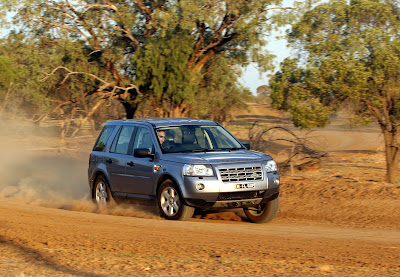
The next day was a whole new world, waking to choruses of crows and magpies in the crisp country air of Charleville. We headed out through rough cattle country leaving satisfying trails of dust, stopping occasionally to open (and close!) gates and pulling up for Cornettos at godforsaken little stores that often required going in search of the owner to complete the transaction. My favourite line, “Do you take Amex?” always got a hearty laugh. This is the outback!

In the 2000-something kilometres we travelled, the little showroom-standard Freelander 2s performed flawlessly. There was the mandatory flooded creek crossing, sand dune bogging, rocky hillclimb and even a bit of wild horse mustering. We weathered countless jibes aimed at our lurid, metallic painted soft-roaders from crusty locals at the many dusty saloons along the way. Clearly the venerable Land Rover had slipped in their estimation in recent years, but that didn’t stop them from coming out for a butcher’s at the little runabouts.

“Nah, ain’t got them things on the troopie mate,” said Mick, the no-nonsense licensee of the Windorah pub out of the slightly curling corner of his mouth, “don’t think you’d sell too many seat warmers out ‘ere.”

So ended our little Leyland Brothers remake (yes, they used Land Rovers once) and we handed back our trusty, mud-splattered mounts with all the hair-shirted satisfaction of knowing we went where no mere sedan could possibly follow.

Liked:

* Remarkably good off road manners, sturdy chassis
* Arsenal of electronic aids and safety enhancements
* Frugal diesel – expect 6l/100km (country) when driven carefully

If we were picky:

* Limitations with underbody clearance excludes really heavy work
* Petrol a bit thirsty for city work (15.8L/100km)

Test Vehicles:

Land Rover Freelander 2 Si6 SE and Td4 SE
3.2-litre i6 petrol (171 kW), 2.2-litre TD4 diesel (118 kW)
6-speed auto, with CommandShift
Full time intelligent four-wheel drive
Si6 SE $49,990, Td4 SE $51.990 *
3 year/100,000 km warranty

Further information: www.landrover.com.au

* Price is a guide only, please refer to your Land Rover dealer for full pricing and options

See PDF

06 July 2009

EASTERN CREEK BIDS FOR WORLD GT1 CHAMPIONSHIP


Sydney's Eastern Creek Raceway is making a strong bid to host a round of the inaugural World GT1 Championship for sports cars in 2010.

The raceway now has four months in which to stake Australia's claim to the ground breaking championship.

The series is being hailed as the first world title that has been purpose-designed for the Internet.

Series promoter, the UK-based SRO Motorsports Group, intends to field a 24 car grid with live "conventional" TV already confirmed across Europe, the Middle East, Asia and South America.

Six of the twelve rounds are locked in and the other six, including Australia, are now on offer and under negotiation.

GT1 vehicles from Nissan, Ford and Lamborghini have been confirmed.

Aston Martin, Audi, Ferrari and Chevrolet have the series under evaluation.

SRO has presented sporting regulations for the fledgling series to the FIA Motor Sport World Council last week.

Confirmation of series venues is required by October and entries must be lodged by the end of November.

Eastern Creek promoter, the Australian Racing Drivers' Club, claims the GT1 World Championship is, "the most cost effective world championship that could possibly come to Australia".

ARDC CEO Geoff Arnold said his group was ramping up its bid to seek support from authorities at local, state, and federal levels.

"Return on investment will be high," Arnold said.

"Conventional TV reach is estimated at more than 150 million viewers, but the true value lies in the net where SRO is developing substantial breakthrough opportunities."

The ARDC has a proposition in front of the NSW Government for a staged upgrade of the 20 year-old state-owned circuit.

However the World Championship proposal does not depend on the improvements being made.

"Eastern Creek's facilities and track design benefit from a Grade 2 FIA Homologation, which is the level required to host a round of the FIA GT1 World Championship," SRO President and CEO Stephane Ratel said.

"One of the attractions of the venue is that it is within the boundaries of one of the world's most desirable cities, and it is walk-in-walk-out."

Mr Arnold said adoption of Phase One of the ARDC's improvement plans would be desirable, but it was not mandatory.

"Our immediate concern is to have relevant tourism authorities buy into the opportunity and partner with us."

SRO is one of the world's most successful motorsport promoters. Its portfolio includes a ten-year involvement with the FIA's European GT Championships and management around the world of another nine national and European titles.

"SRO's credentials are impeccable and their offer is compelling," Mr Arnold said.

"Tourism and sporting authorities should take this opportunity very seriously and work with us to explore the potential."

Eastern Creek celebrates its 20th anniversary as a race track this year.

It was purpose built to host the world Moto GP Championships, which it did for seven years, before the title was taken back by Victoria's Phillip Island circuit.

"Eastern Creek is now Sydney's only permanent race track and it is one of only a handful of government-owned permanent motor racing facilities," Mr Arnold said.

"It is the logical venue to bid for this series."

02 June 2009

Subaru: When the Going Gets Tough

OUTthere Issue 60 - All Torque

In just 35 years, Subaru has flourished in a land known for its hard knocks and even harder drivers.

Subaru’s 1973 entry into the Australian automotive marketplace coincided nicely with flared trousers, platform heals and the euphoria of a new reformist government under Gough Whitlam.

The awkward-looking Subaru Leone was reminiscent of the lonely geek in the corner at the party and ownership was for those attracted to the little sedan’s undeniable practicality and reliability. Style and street ‘cred’ would have to wait.

We saw a glimpse of the future when the unknown actor Jackie Chan piloted a wild, high performance Subaru Station Wagon in 1981’s madcap ‘Cannonball Run”, even if it was disguised as satire. Today, Subaru’s ‘recreational’ wagons, the all-wheel-drive (AWD) Outback and Forester, deliver a staggering performance package in line with their ‘drivers’ stable mates, the Impreza and Liberty.

Unlike the front-wheel-drive Leone of the ‘70s, Subaru have only offered AWD vehicles in Australia since 1998, reinforcing their niche specialty in driver-focused performance and recreational vehicles. So successful have Subaru been that, in the right (or wrong) hands, Subaru’s WRX Impreza is an uncatchable getaway car!

A lot has changed in 35 years and one thing is certain, people don’t point and giggle when you rock up in a Subaru these days. After total domination of our local rally championships until 2005, Australia is now the third biggest market worldwide for Subaru vehicles, after Japan and the United States.

For the regional user, Subaru’s promised diesel engines are possibly the most exciting development and Australia will see them here shortly.

Subaru Australia MD, Nick Senior
All Torque spoke with Subaru MD, Nick Senior, about the present and future Subaru.

All Torque: Subaru enjoys a strong position in the Australian marketplace. How does the company expect to meet the challenges ahead?

NS: Our unique combination of Symmetrical All-Wheel Drive and Boxer engine continues to be our unique selling proposition. Combined with our safety focus, engineering reputation, durability and proven whole-of-life costs, it makes Subaru a compelling proposition - especially in an economy where people are looking for low-risk, proven performers. The fact that our range covers everything from niche performance models such as Impreza WRX STI to Australia's best-selling compact SUV in the form of Forester, means we have products that appeal to a wide variety of audiences and we believe this positions us well for the future.

All Torque: What is Subaru’s take on the current market and which models are standout performers?.

NS: As with so many industries currently, the automotive market is very tough. However, this has actually presented an opportunity for us, with the attributes outlined above actually attracting new as well as existing customers to Subaru. For example, new generation Forester was Australia's best selling compact SUV last year and is presently the best selling SUV across all categories so far this year. New generation Impreza is achieving our best-ever small car figures and our largest vehicle, Tribeca, has introduced Subaru to a whole new set of customers, looking for a larger vehicle. Together with the new generation Liberty and Outback which will be introduced in September, this gives us cause for optimism in challenging times. It's also encouraging for us that we are selling an increasing volume of range-topping vehicles.

All Torque: Subaru are well known for technical innovation. What new engineering and planning exercises are ahead?

NS: Without giving any secrets away, we have some exciting technologies pending, including the introduction constantly Variable Transmission (CVT) options in our new generation Liberty. This contributes greatly to fuel economy and performance. At the end of the year we will also introduce our first diesel variant, in an Outback. This engine has been getting rave reviews in Europe for its low fuel consumption and refinement, and we've had a lot of interest already. We're also introducing a six-seat family wagon, the Exiga, late in the year. This will expand our appeal to families, with a versatile and spacious cabin that underlines the clever use of interior space by Subaru engineers.

All Torque: Is Subaru exploring hybrid or other “low carb” alternatives?

NS: We demonstrated the plug-in STELLA electric concept in the lead-up to Melbourne Motor Show. This four-door micro car has a range of 80 kilometres, a top speed of 100 km/h and can be recharged to 80 per cent of capacity in just 15 minutes, using a special fast charger, or plugged into a home outlet overnight for a full recharge. This car is going into limited production for sale in the Japan domestic market as a city commuter, from June. It's an exciting development which will be refined and developed considerably in the coming years.

All Torque: Will Subaru diesels find their way into other models here in Australia?

As mentioned, we will launch Outback diesel at the year's end. We've had some cars on test and have been delighted and amazed by the fuel consumption figures we've returned. Depending upon the level of interest, yes, we may have the option to expand this engine into other models in our range.


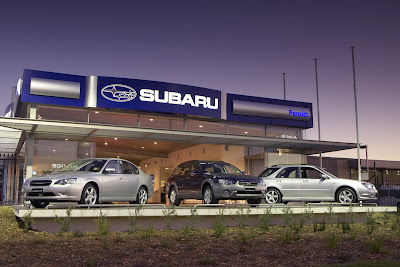
Subaru has 106 dealers across Australia with an excellent rural and regional coverage from Broken Hill to Kalgoorlie.

For more information about Subaru vehicles, call 1800 22 66 43 to find your local dealer or visit the comprehensive website: www.subaru.com.au

02 May 2009

Hummer – 4WD That’s OUT TH3RE

OUTthere 59 - All Torque


Like the original GP (General Purpose) “Jeep” of WWII, the modern equivalent, the High Mobility Multipurpose Wheeled Vehicle (HMMWV or Humvee®) will go down in history as one of the most successful, widely used military vehicles of all time.

After a successful bid by AMC (American Motors Corp) in 1981, the US Government awarded an initial contract for 55,000 units and the rest is, as they say, history. Some 200,000 vehicles are now in use by more than 50 nations’ armed forces, paramilitaries and civilian defence units.

With their high profile success in military operations such as ‘Desert Storm’ during the 1990s, there was a predictable demand for a civilian version and the H1 was conceived. Based on the original Humvee platform, you won’t get ballistic protection as standard, nor will “machine gun turret’ appear on your option list. The H1 was discontinued in 2006.

AM General sold the ‘Hummer’ brandname to GM in 1999 and began producing the H2 based on existing commercial truck chassis platforms with only external similarity to the original Humvee. Engines are 6 litre petrol V8s compared to most H1s being fitted with 6+ litre V8 diesels.

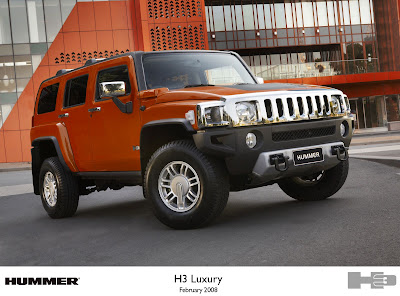
Introduced in 2006 and powered by a 3.7 litre, five cylinder petrol engine producing 180kW and 328 Nm, the H3 shares its platform with GM stablemates, Colorado and Canyon. In Australia, the H3 is available in both manual and automatic transmission connected to a two-speed, electronically-controlled, full-time 4WD system with both stability and traction control.

Sold as a mid-size SUV the interior, including luggage space is constrained and a bit difficult to pack a full holiday. Two passengers can fold the rear seat for added capacity.

The H3’s road manners are surprisingly good, delivering a smooth, confident ride and easy steering. Off road, the little H3 is a proper 4WD and made easy work of the tasks we threw at it. Shallow river fording, rocky and slippery exits, bumps, humps and trenches were all consumed with ease. Decent underbody clearance (216mm) with limited front and rear overhang meant we never scraped anything. Even if you want to extend the H3’s capabilities, an optional Adventure pack is available, adding $6k to the pricetag.

The petrol engine is adequate but not startling and is rated at 13.5 litres/100km for the auto transmission and slightly less for the manual. Payload is about 430kg and towing with the automatic transmission is a generous 2 tonnes. Fuel tank capacity is 87 litres. A turbo diesel variant is being discussed and would be welcome addition to the range.

The base model H3 sells for $52,990 up to $60,990 for full specification luxury and is sold through 21 dedicated dealers nationwide. See: www.hummeraustralia.com.au.

For those hankering for the heavy metal, H2 Hummers are available by private import through American Vehicle Sales in Melbourne typically upward of $100k. See: www.hummer.com.au

Want to drive one but don’t want to own one? The Supercar Club includes a spanking 6.0 litre, black Hummer H2 as part of its membership fleet of exotic sports cars, sedans, SUVs and coupés. Members pay an annual fee to drive their collection of otherwise unattainable cars that also includes a Lamborghini Gallardo Superleggera and a $1.3million Rolls Royce Phantom Drophead Coupe. See: www.supercarclub.com.au

Stop Press: At time of writing, General Motors was still reviewing its options for the Hummer brand which could include outright sale or closure. Apparently interest has been shown by automakers in India, China and Russia with India’s Mahindra the most likely contender.

01 April 2009

Holden Celebrates 60 Years as “Australia’s Own”

OUT There 58 - All Torque

Roderick Eime reviews the Lion’s progress.

Before General Motors Holden re-occupied their factory at Fishermen’s Bend after the Second World War, the product was flying out the door at 500mph.

During the desperate days of WWII, Fishermen’s Bend was turning out Beauforts and Beaufighers and developing the superior interceptor, the CA-15 Kangaroo. But with the end of war in sight, it was decided that Australia should develop its own car and the 48-215 (FX) was born inside the war machine.

The stylish, American-designed 6-seater was an instant best seller and now, 60 years later, Holden’s mainstay is still the country’s top selling sedan. Commodore first hit the streets in 1978 (VB), borrowing designs, not from the USA, but from European sibling, Opel. The venerable 202ci (3.3 litre), six cylinder engine still owed much of its technology to the original 132ci (2.15 litre) six in the 1948 FX.

The clunky 202 finally gave way to a silky smooth Nissan-sourced 3-litre SOHC six for the 1986 VL model. In 1988, the all-new top-to-bottom VN Commodore was released powered by the Buick 3.8 litre V6. The old-tech pushrod design drew murmurs from the critics, but the new Commodore was just the weapon Holden needed to counter its main rival, the Ford Falcon. By 1996, the Commodore was back on top and that’s where it has stayed.

Sales figures for 2008 released by the Federal Chamber of Automotive Industries show Australians purchased a total of 51,093 vehicles from the VE Commodore range.

Apart from the Kingswood-Commodore mainstay Holden, through GM international family brands Isuzu, Opel, Vauxhaul and Chevrolet, have introduced a wide variety of vehicles into the Australian market. From tiny Barinas to the gargantuan Suburban and Hummers, the range has had a model to suit all tastes and budgets.

Rural buyers have always been loyal to the Red Lion, buying utes, sedans and workhorses like the Rodeo. From 1980, the Isuzu-built Rodeo has been a popular 2WD and 4WD cab and trayback model for farm and trade work. In 2008, Holden introduced the Colorado model, based on the new generation Isuzu D-Max. In something of a marketing and branding shuffle, Isuzu D-Max utes will now also be sold and serviced separately through a new, independent dealership network.

In the dedicated 4WD and SUV market, Holden pinned its fortunes on the dainty Jackaroo for twenty years. Another rebadged Isuzu product known elsewhere in the world as Trooper and Monterey, it was discontinued in 2003. The AWD Adventra (Commodore) filled the gap uneasily until the introduction of Captiva in 2006.

Built by GM subsidiary Daewoo, the Captiva was inspired by the Chevrolet S3X concept unveiled at motor shows around the world in 2004. The style thematic is common across modern urban SUVs such as Honda’s CRV, Audi X3 and Volvo XC60 giving it a contemporary and sophisticated look. Today’s Captiva is certainly a long way removed from the early bouncy, boxy Jackaroos.

The man on the land, this land in particular, invariably has long distances to travel. Cruisey sedan-based, long wheelbase limousines like the Statesman have been a part of the Holden line-up since the legendary HQ was introduced in 1971. To counter the market domination by Ford’s Fairlane, Statesman added three inches to the wheelbase with most of the space dedicated to rear passenger legroom.

Statesman (and the up-rated Caprice) has always occupied the position of flagship in the Holden passenger range. The latest incarnation (WM) appeared in 2006. Powered by the current 3.6 litre V6 and 6.0 litre V8, the model is exported and rebadged under Buick, Daewoo and Chevrolet to such markets as Korea, China and the Middle East. As of Januray 2009, the V8 range will feature new Active Fuel Management (AFM) technology. Known elsewhere as “cylinder deactivation”, the system will cut fuel to four cylinders under light load to improve fuel efficiency.

Holden’s crystal ball shows a new small car production line planned for Adelaide in 2010 that will give the Australian automotive industry a new focus and pave the way for alternate fuel technologies like LPG, ethanol blends and Compressed Natural Gas (CNG).

To recall Henry Ford’s famous quote; “You can have any colour you like as long as it’s black.” It seems GM green is the new black.

[ View as magazine layout PDF ]

Last Month's Most Popular Posts